Category: Uncategorized

  • Celebrating California’s AB1098

    Celebrating California’s AB1098

    The Pregnant Scholar team is celebrating the introduction of California bill AB 1098. This bill, sponsored by CA Higher Education Committee Chair Mike Fong, would ban discrimination on the basis of pregnancy and parental status in higher ed, and put into California law critical protections for pregnant and parenting students such as pregnancy accommodations and parental leave. California is poised to be the first state to implement strong protections for pregnant and parenting students since federal protections were rolled back this January.

    Learn more:

    Our organization’s history is directly tied to the section of the Education Code that AB 1098 seeks to amend. Pregnant Scholar’s Co-Founder, the late Professor and former UC Berkeley Graduate Dean Mary Ann Mason, fought to create the section after observing pregnant students being denied changes to stay safe during pregnancy, mothers denied readmission after giving birth, and parents being told they would have to choose between their education and being engaged in their child’s life. We launched the Pregnant Scholar in early 2015 to help ensure the promise of that law was met, and in the ten years that followed we’ve seen remarkable results in keeping pregnant and parenting graduate students enrolled. But these problems weren’t limited to graduate students; undergraduates need protection, too.

    The Pregnant Scholar has received hundreds of calls to our free legal helpline from undergraduate students in California struggling to continue their education due to institutional barriers that AB 1098 would address:

    “Anne” was a student in the final months of her program when she was diagnosed with life threatening pregnancy complications. She needed regular doctors’ appointments to ensure her safety, yet Anne was told that if she missed even a portion of her daily class her overall grade would be cut by 10%. While remote work was available, Anne was denied access to it. She attempted to advocate for herself, even reaching out to her college’s president, only to be told there was nothing that could be done and that he “didn’t know what Title IX had to do with her.” Anne’s only options were to risk her life or drop out of school and risk her ability to provide for her growing family.

    “Kate” remained enrolled throughout her pregnancy, even doing physically grueling field work, because no one told her she was eligible for Title IX accommodations to protect her health. Kate had life-threatening complications and delivered via c-section just as the semester began. The day after being discharged from the hospital she tried to go back to school, but was told that she had been dropped for not attending her first week of classes and would not be let back in.

    “Benita” was a pregnant student suffering from severe pregnancy-related carpal tunnel syndrome, which made typing extremely painful. When she reached out to student affairs for assistance, instead of being connected with the available accessibility supports, she was advised to withdraw from her program.

    “Michael” was a new father of twins in the Neonatal Intensive Care Unit, while his wife was hospitalized due to complications from childbirth. When he requested to postpone an exam to care for his critically ill children, he was told it was “his wife’s job” to handle such matters and that if he missed the test, he would fail without any guarantee of being able to return.

    AB 1098 provides essential safeguards to ensure that what happened to these students does not happen to anyone else. First, the bill establishes a clear right under state law for pregnancy-related accommodations. AB 1098 would require that pregnant and postpartum undergraduates be provided reasonable accommodations, such as avoiding toxic chemicals or having access to more frequent bathroom breaks when needed. The comprehensive guidance within the text will ensure that the standards are well understood and easy to follow on campus. No pregnant student should be forced to choose between their health and their education—this bill would make sure that doesn’t keep happening in our state. 

    Next, AB 1098 would ensure that undergraduates, like graduate students, can take parental leaveand then return to their studies afterward. This provision is critical to preventing student parents from having to drop out—or being kicked out—due to childbirth recovery or infant care needs. Despite existing Title IX protections for medically necessary absences, we frequently hear from students who are pushed out of programs they have invested thousands of dollars and years of their lives into, resulting in long-term economic insecurity for their families. AB 1098 would help keep students on track to earn their degrees and achieve the brighter futures that come with completing their education.

    Furthermore, AB 1098 would improve compliance by ensuring that college and university faculty, staff, and students are aware of the protections the law provides. Many institutions have complex processes for managing childbirth leave, health accommodations, or responding to harassment. This bill would prevent problems by requiring institutions to inform pregnant students of their rights and how to access support, and to adopt and publish written policies. These are best practices that will prevent discrimination and barriers to pregnant students’ educational access.

    This bill could not have come at a better time. The Department of Education’s Office of Civil Rights, which is tasked with enforcing Title IX protections for pregnant and parenting students, has been gutted. The San Francisco office was shuttered, leaving over a thousand cases in limbo and causing uncertainty as to whether the Department will investigate complaints. It is imperative that the state step in to provide the guidance our students and educational institutions are no longer receiving from the federal government.

    AB 1098 would prohibit at the state level discrimination based on the student’s current, potential, or past pregnancy related condition or parental status—ensuring that our students are safe from attempts to roll back the scope of federal protections and enforcement. The bill’s sections on pregnancy discrimination, medically necessary leave and accommodations align with the Department’s 2024 Title IX Rule, which was implemented following years of public comment and review. These provisions have received widespread support, and most CA educational institutions are already familiar with them. By enacting AB 1098, California can guarantee that our colleges and universities consistently provide equal educational opportunities to pregnant and parenting students, regardless of the turmoil in Washington.
  • Pregnant Scholar Director for Ed Trust: Centering Student-Parents Can Help Foster Student Diversity

    Pregnant Scholar Director for Ed Trust: Centering Student-Parents Can Help Foster Student Diversity

    Supporting student parents world be an effective way for colleges to counter bans on affirmative action and DEI and promote diversity in higher education, writes our Director Jessica Lee for the Education Trust’s Equity Line blog.

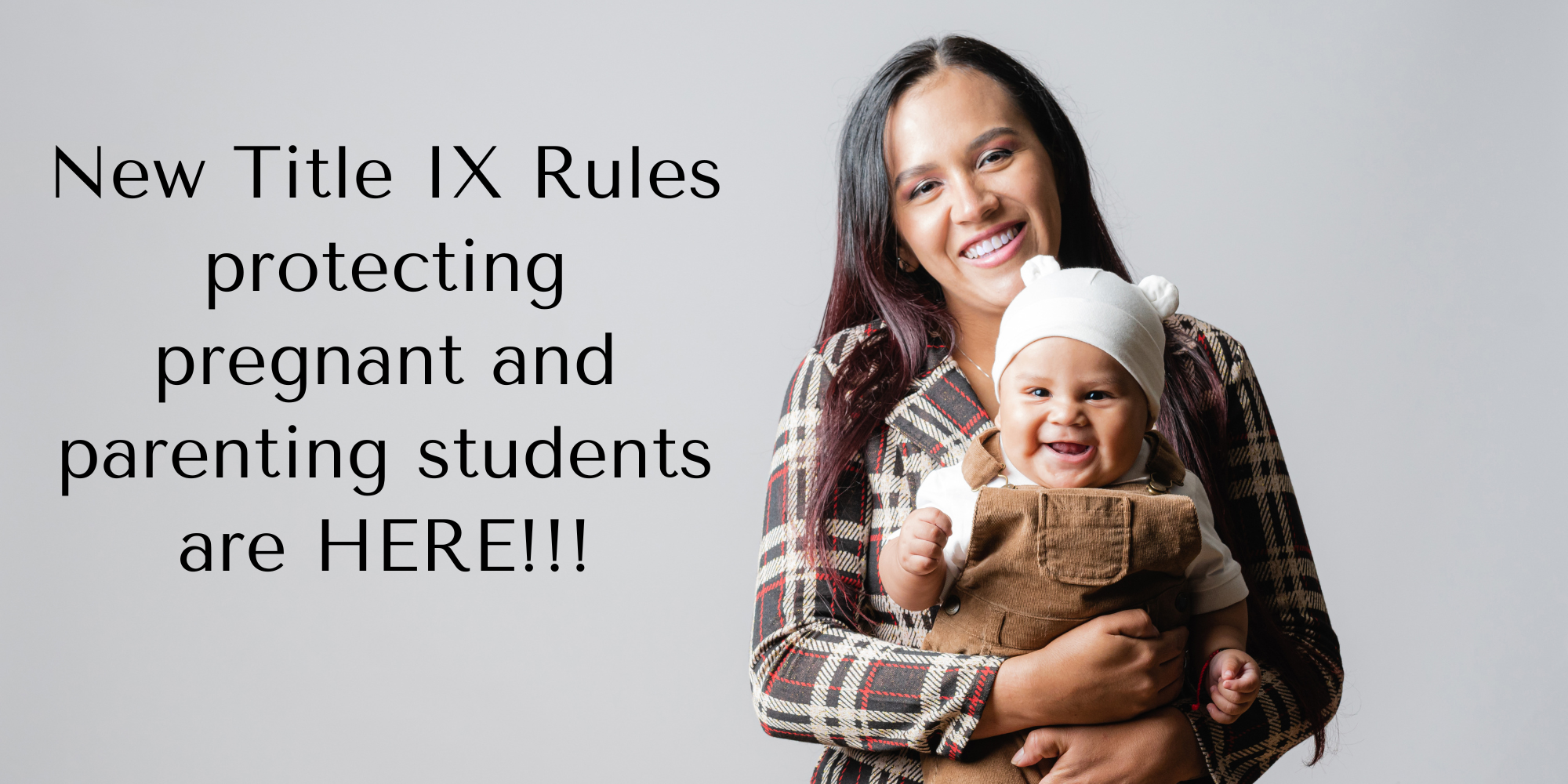
  • New Title IX Rules Released

    New Title IX Rules Released

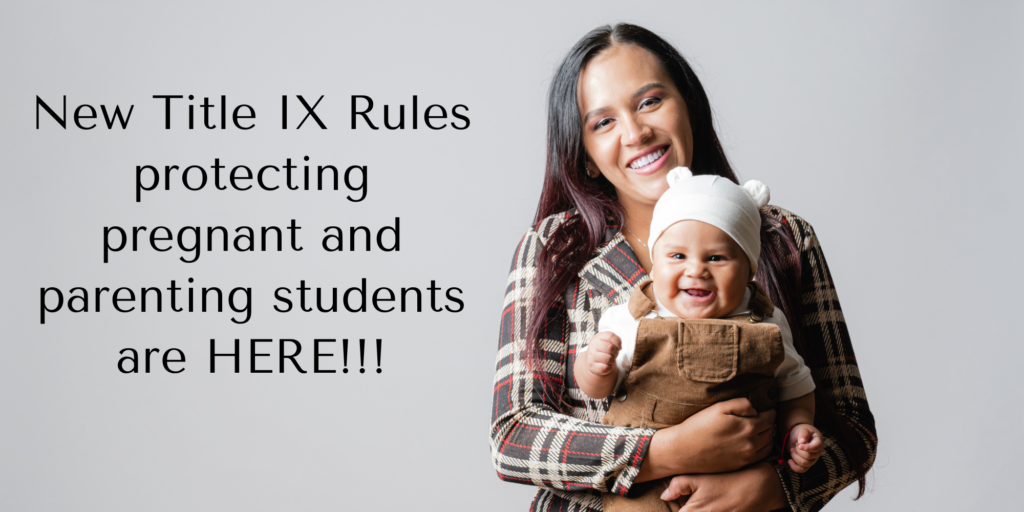
    After nail-biting years of waiting, the new Title IX regulations are finally here!

    Today the U.S. Department of Education released its final regulations implementing Title IX, the federal law that prohibits sex discrimination in education. The Pregnant Scholar at UC Law SF’s Center for WorkLife Law applauds the Department of Education for providing a strong interpretation of the law that both protects millions of pregnant and parenting students and provides clear guidance for educational institutions. 

    Under the old rules, pregnant and parenting students regularly called our nationwide helpline after being kicked out of their academic programs for missing a couple classes to attend doctor’s appointments, told they were no longer welcome in school, or forced as part of their academic requirements to engage in activities that aren’t safe during pregnancy or postpartum. The Department of Education’s new Title IX rules will safely keep students in school, and their families and communities will benefit as a result.

    In particular, we’re thrilled to see the new regulations:

    • Include a clear requirement for academic institutions to provide pregnant and postpartum students with medically-necessary leave, reasonable accommodations, and lactation space. 
    • Clarify who is responsible for ensuring students get the reasonable academic adjustments, leave, and anti-discrimination protections they need to thrive. And, require staff to notify students of where they can find help.
    • Continue to ban discrimination based on pregnancy-related conditions including abortion and miscarriage, and newly define ‘parental status’ in a way that reflects the diversity of student parent families. 
    • Offer privacy protections–a particularly important safeguard post-Dobbs.

    Our team pushed hard for these regulations for years because of the transformation we know they’ll bring– now it’s time to celebrate! Thank you and well done to all of you who joined us in sharing your stories, submitting comments, and spreading the word. 

    What’s next?

    The new regulations represent the highlight of nine years of tireless work alongside students and other partners. But our work is far from over. This year, the Pregnant Scholar will train thousands of campus administrators on the new regulations and provide technical assistance and policy implementation coaching to benefit campuses serving over a million students. We are also re-creating all of the tools in our online resource center to reflect the new regulations. Please, join us:

    • Visit our Toolkit: Updates to reflect the new Title IX rules are underway
    • Join our webinar: Our first (free) training on the new regulations will be May 1st!
    • Join a Drop-In TA session: Beginning in May, we’re hosting “Title IX Tuesdays” drop-in technical assistance sessions for campus administrators working to implement new policies re: pregnant and parenting students. Sign up for an access code.
    • Spread the word: share the news that the new rights are here using our graphics and posters.

    Finally, I hope you’ll roll up your sleeves. While remarkable, the new regulations do not significantly address the needs of parenting students beyond the pregnancy and postpartum period. The Pregnant Scholar will continue advocating and engaging at the institutional, state, and federal levels to end discrimination against student parents and to ensure that all family caregivers are supported in earning their degrees. We hope you’ll stand with us in this next phase of our journey.

    Warmly,

    Jessica Lee

    Director, Pregnant Scholar Initiative

    Incoming Co-Director, Center for WorkLife Law, UC Law SF


  • New Draft Title IX Rules Released

    New Draft Title IX Rules Released

    Today is the 50th anniversary of Title IX being signed into law! While the landmark law prohibiting sex discrimination in education has long protected pregnant and parenting students, we know more protections are sorely needed to make Title IX’s promise of gender equity in education a reality. The Pregnant Scholar applauds the Department of Educations’ just-released proposed Title IX regulations as they relate to students who are, or will become, pregnant or parents. While further actions are needed to protect student parents, we encourage the adoption of these draft regulations without delay. 

    What’s in the proposed regulations? 

    In addition to making changes to the handling of Title IX complaints, and other broad changes, the proposed new rules include several changes to make the rights of pregnant students clearer and easier to safeguard. We provide an overview of some key changes below. 

    The draft regulations, if enacted, would: 

    • Define pregnancy and conditions related to pregnancy more consistently, and clarify that pregnancy includes potential, presumed, or past pregnancy, as well as related conditions and recovery from related conditions. This is critical for protecting students’ health, and for guarding against discrimination based on presumptions about someone’s fertility or family status. Of particular importance in light of the Dobbs decision, the definition of pregnancy and related conditions continue to include miscarriage and abortion (the phrase “termination of pregnancy” in the regulations is a legal term covering abortion, miscarriage, or other pregnancy loss).  
    • Recognize lactation as a pregnancy-related condition and set requirements for lactation break time and space. Under the new regulations, employees and students must be provided lactation space which is not a bathroom, and is clean, shielded from view, free from intrusion, and may be used for expressing breast milk or breastfeeding as needed. These requirements mirror existing state and federal workplace lactation laws that apply to most workers nationwide. The Department rightfully pointed out in the discussion that, “Lack of access to lactation space … could cause the student to miss school, quit school, or be unable to express breast milk or breast feed and, as a result, experience potentially painful physical side effects that prevents the student from fully accessing and obtaining the benefits of the recipient’s education program or activity.” 
    • Requires educational institutions to provide information to pregnant students on their rights. Currently schools are only required to have a Title IX coordinator and make their contact information publicly available. Under the new regulations, whenever any school employee learns that a student is pregnant or experiencing related conditions (from the student or someone on their behalf), they must inform the student how to seek assistance from the Title IX coordinator and provide relevant contact information. The Title IX coordinator will be required to 1) inform students of their rights to non-discrimination; 2) offer reasonable modifications (also known as reasonable accommodations or academic adjustments); 3) allow the student access to a separate and comparable educational program, if the student elects to join it; 4) allow voluntary leave; 5) provide lactation space; and 6) inform the student of applicable grievance procedures.  
    • Makes clear pregnant students’ rights to academic adjustments/modifications to policies, practices, procedures. While the Department of Education has long required certain reasonable adjustments be made to protect the pregnant students’ health and enable their continued education, the requirements have been difficult for many institutions to understand and implement. The new regulations make clear that educational institutions must provide reasonable modifications to policies, practices and procedures when needed for pregnancy or related conditions. These adjustments must be agreed to by the student and individualized to the students’ needs. Academic adjustments might not be required if the educational institution can show that making the change would “fundamentally alter” the education program. That standard has long been in place, and means schools wouldn’t have to make a change so significant that it “alters the essential nature of the recipient’s education program or activity.” 
    • Requires the Title IX Coordinator to ensure reasonable modifications are provided to pregnant students who need them. This would include, “determining what modifications are appropriate with input from the student and any other necessary individuals, communicating approved modifications to the student and any relevant staff members, ensuring that all other staff members involved in carrying out the modifications were performing their roles, and documenting when and how modifications took place.” In other words, the Coordinator would be tasked with ensuring the modifications are provided in practice, not just on paper. This is a critical step as currently many Title IX coordinators report struggling with requiring faculty members to provide reasonable accommodations for pregnant students. Now it is clear that the Title IX Coordinator has the authority, and the obligation, to do so. 
    • Eases access to leave for pregnant and birthing students. Title IX regulations have long required that medically necessary leave be provided to students for pregnancy, childbirth, recovery and related conditions. The new regulations make this requirement even clearer, and now also permit documentation from a licensed healthcare provider other than a physician to serve as documentation of medical necessity. Expanding the range of healthcare providers is useful as many pregnant students receive care from midwives, registered nurses, lactation consultants, and other non-physicians. 
    • Limits requirements on students to provide medical clearance in order to continue their studies. The old regulations allowed schools to request certification (e.g. a doctor’s note) that a pregnant student was physically and emotionally capable of continuing their studies, so long as other students with health conditions were also required to provide certification. Now, emotional ability is no longer considered, and certification can only be required if  “(i) the certified level of physical ability or health is necessary for participation in the class, program, or extracurricular activity; (ii) the recipient requires such certification of all students participating in the class, program, or extracurricular activity; and (iii) the information obtained is not used as a basis for discrimination prohibited by the regulations.” The new regulations reduce the risk of a student being excluded from their educational program due to pregnancy and make it easier for all stakeholders to assess when such certification is appropriate. 
    • Defines parental status in keeping with other federal laws. The regulations continue to prohibit discrimination on the basis of sex in relation to any policy on parental status. The proposed definition of parent includes caring for child or someone who needs care due to disability, including biological parents, adoptive parents, stepparents, foster parents, legal guardian, and people filling a parental role (standing “in loco parentis”).  
    • Requires monitoring. Title IX Coordinators will be required to monitor their institutions’ educational programs “for barriers to reporting information about conduct that may constitute sex discrimination under Title IX…” Documenting barriers aids critical data collection and supports future action steps to best support pregnant and parenting students.  

    What’s missing? 

    While the regulations make clear many protections for students who are or were pregnant, parenting students still need more protection. For example, while a student would be entitled to time off from school for pregnancy or childbirth, under the draft and current regulations they would not be clearly entitled to time off to care for their child’s health needs. Parenting students have repeatedly raised the need for accommodations to address their caregiving needs and have identified the many ways sex stereotyping informs these issues. Stay tuned for additional analysis and advocacy opportunities related to parenting students’ unique needs. 
     

    What’s next? (Updated January 2023)

    After the regulations were proposed, there was a 60 day public comment period. The Pregnant Scholar Initiative is proud to have submitted formal comments to the Department of Education regarding the proposed regulations. While we applaud the progress the proposed regulations will bring, they do not reach far enough to protect against all forms of sex discrimination that pregnant and parenting students face. For this reason, our comments contain suggested changes and additions to the rules. The Pregnant Scholar was joined in this effort by hundreds of organizations, advocates, and current/former student parents. Read the letters here.


    The new regulations are expected to formally take effect in May 2023.

  • New Research: Medical Student Parental Leave Policies at U.S. Medical Schools

    New Research: Medical Student Parental Leave Policies at U.S. Medical Schools

    New research from the Pregnant Scholar and a cross-institutional team revealed that amongst the top-rated medical schools only 14% of the schools reviewed had substantive, stand-alone parental leave policies, while the majority of schools had leave of absence policies without mention of parental leave. The article, Medical Student Parental Leave Policies at U.S. Medical Schools, was published in the Journal of Women’s Health, and provides critical insight for medical school leaders seeking to improve diversity and equity at their institution.

    Cover of Journal of Women's Health, bright red with white lettering

    The authors, who bring decades of experience in the legal and medical fields designing bias interrupters and advancing diversity in STEM education, offer unique insight into designing policies which support pregnant and parenting medical students in compliance with the law. From the abstract:

    “Best practices utilized by institutions with the most robust parental policies include adopting a formal and public parental policy, providing a parental enrolled academic adjustment option, guaranteeing approval to take and return from leave/academic adjustment, and continuing health care and financial aid benefits. Given the role of childbearing as a factor associated with gender disparities in academic medicine, and potential impact on racial disparities for students of color, medical school leadership should consider implementation of best practice parental policies to promote equity and wellness of their students. In fact, the deficit of robust parental leave policies in most highly ranked schools may contribute to existing gender and racial disparities in violation with antidiscrimination law. Strengthening policies could increase equity in medical education with positive impacts on the patient population.”

    Danielle Roselin, Jessica Lee, Reshma Jagsi, Mary Blair-Loy, Kim Ira, Priya Dahiya, Joan Williams, and Christina Mangurian. Medical Student Parental Leave Policies at U.S. Medical Schools, Journal of Women’s Health (ahead of print) http://doi.org/10.1089/jwh.2022.0048

    For questions about this research, or for free institutional support implementing family-responsive policies, contact us.

  • University Examples: University of California Policies for Pregnant and Parenting Students and Postdocs

    University Examples: University of California Policies for Pregnant and Parenting Students and Postdocs

    The Pregnant Scholar is always looking for examples of what works in supporting pregnant and parenting students. Our users can submit examples of promising university policies or practices for inclusion in our directory and/or blog.

    Smiling mother taking baby for walk on campus.

    [button size=”medium” icon=”” target=”_self” text=”Share Your Policy” link=”https://staging.thepregnantscholar.org/contactus/share-best-practice-example/”]

    One of the first university systems to protect student parents with parental leave polices was the University of California. Although the ten campuses of the UC system have long had provisions to offer paid leave for some employee parents, the UC has recently expanded its efforts to provide paid leave and unpaid academic leave to more of its community.

    We’ve seen big changes in parental leave policies recently:

    • All graduate student employees are entitled to paid leave.  The parental leave provisions of the UC and Academic Student Employees CBA (pg 20-22), which have been extended to non-union Graduate Student Researchers as well, provide:
        • Unpaid pregnancy/childbirth disability leave (4 months), as protected by CA and Federal Law
        • Six weeks of paid leave for pregnancy disability, childbirth, and related medical conditions (plus two weeks unpaid “baby bonding” leave); or,
        • Four weeks of paid leave to care for a family member or newborn/newly adopted child (plus two weeks unpaid “baby bonding” leave)
    • All UC campuses now provide a year of academic leave for graduate students, as called for in the newly changed CA education codeUC campuses also provide extensions in time to take preliminary and qualifying examinations, and offer part time or reduced study options.
    • UC Postdocs now have access to both childbirth recovery leave and parental leave. Beginning in late 2016, the new Postdoc contract provides:
        • 4 weeks of paid parental leave
        • Unpaid leave, as protected by CA and Federal Law for postdoc employees
        • 24 workdays of paid time off, and 12 days of paid sick leave
        • Unpaid pregnancy/childbirth disability leave (4 months).
    • Some UC campuses have educational leave programs that provide a clear path to leave for undergrads who need to take time off for pregnancy, childbirth, or parenting.

    In addition to these  policies, departments are taking action to properly communicate priorities around protecting student parents.  For example, Berkeley began including a notice of accommodation for pregnant and parenting students in its campus-wide notice on student accommodations.  The notice reminds instructors of their responsibilities to excuse students’ medically-necessary absences and make accommodations.  The Berkeley graduate Division is also tracking the usage of it’s new leave policy to ensure it is being implemented effectively.

    More work is needed to expand these policies to undergraduates and to foster a supportive culture for student and postdoc parents—but these policies and practices lay a promising foundation.  In particular, these comprehensive policies are proof that public institutions can—and do—provide paid parental leave to students and postdocs.

    Have questions about implementing similar policies on your campus? Explore the Pregnant Scholar policy resources, and click here to contact us for assistance.

  • Frozen Eggs and Title IX

    Frozen Eggs and Title IX

    If you’re counting on that procedure to delay your family while you get your career going, think again

    (more…)

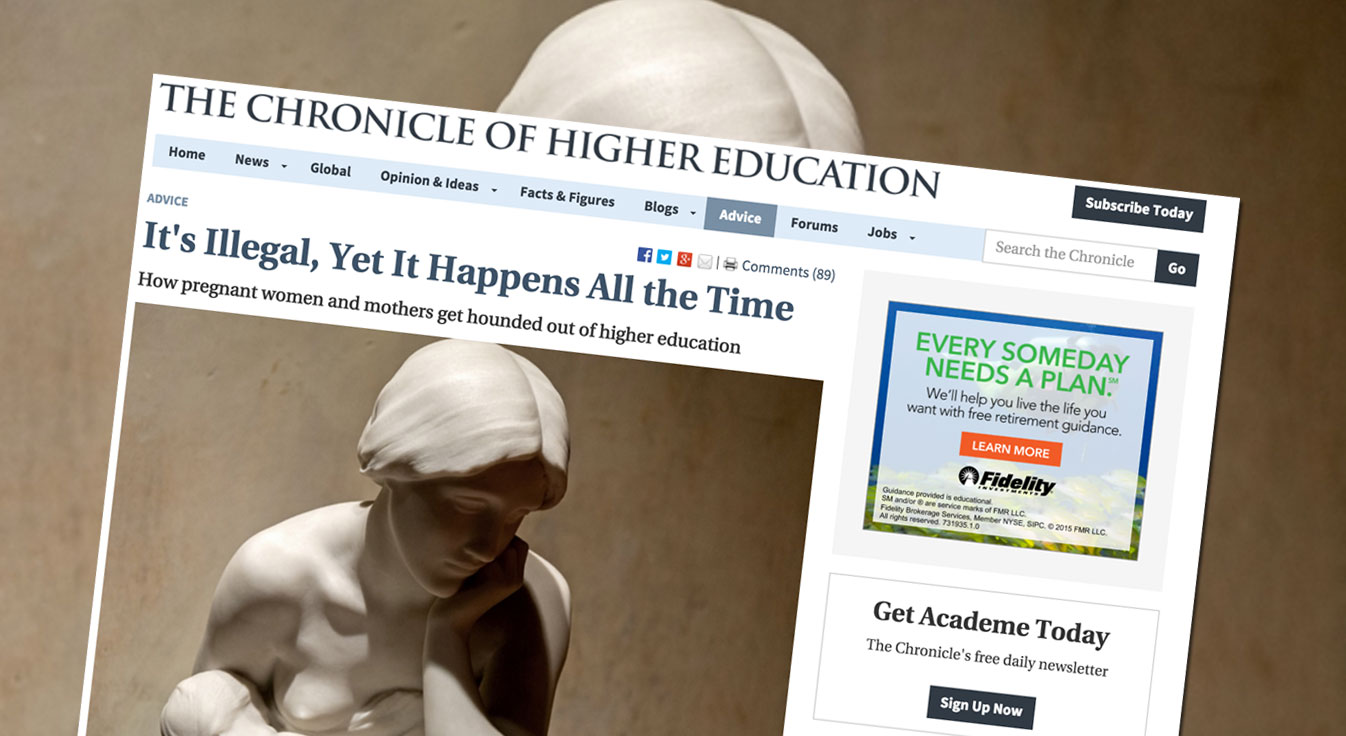
  • It’s Illegal, Yet It Happens All the Time

    It’s Illegal, Yet It Happens All the Time

    How pregnant women and mothers get hounded out of higher education

    Why don’t we have more women in STEM fields?

    (more…)

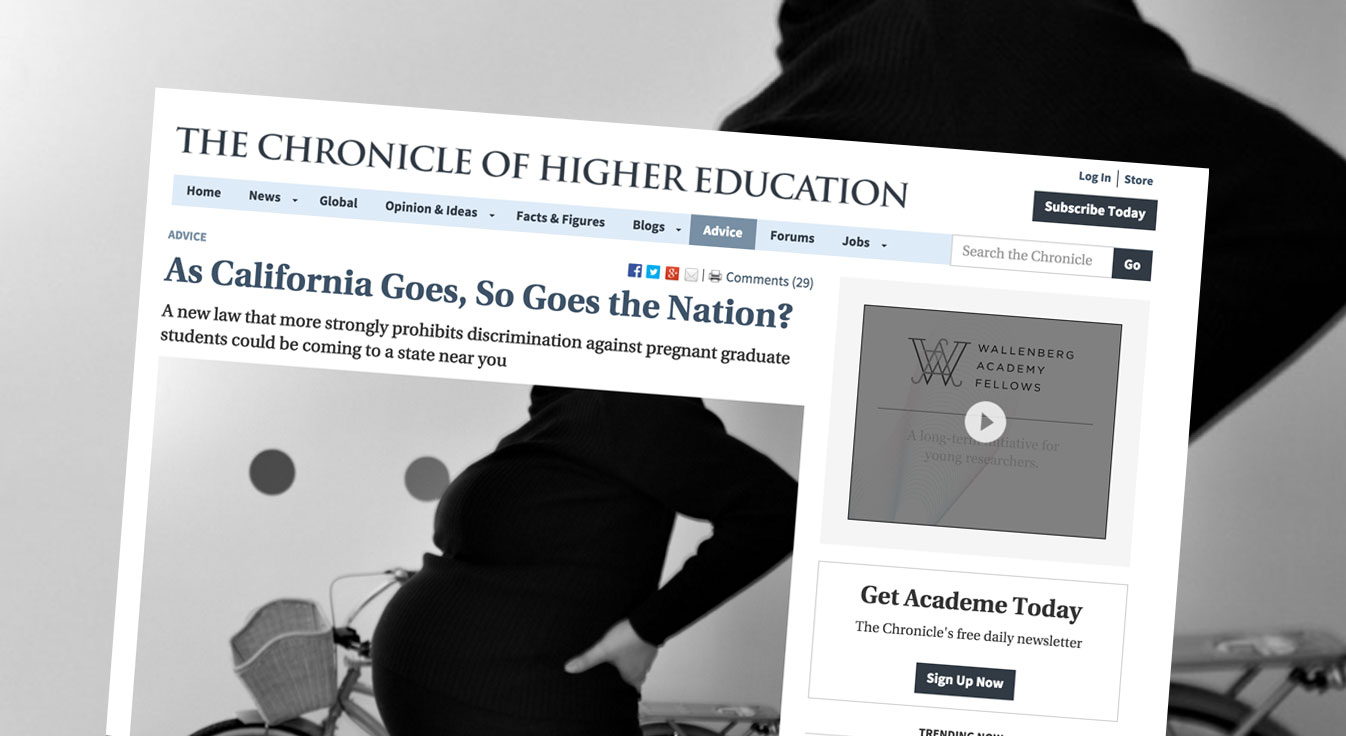
  • As California Goes, So Goes the Nation?

    As California Goes, So Goes the Nation?

    A new law that more strongly prohibits discrimination against pregnant graduate students could be coming to a state near you

    (more…)

  • TITLE IX AND PREGNANCY DISCRIMINATION: WHO KNEW?

    TITLE IX AND PREGNANCY DISCRIMINATION: WHO KNEW?

    (AWIS Partner in Tools for Change)

    Established by Congress in the peak years of the women’s rights movement, Title IX promised to overturn years of bias by banning sex discrimination (more…)