Author: Erin Frawley

  • PREGNANT SCHOLAR PROFILE: Guyshana Alston

    PREGNANT SCHOLAR PROFILE: Guyshana Alston

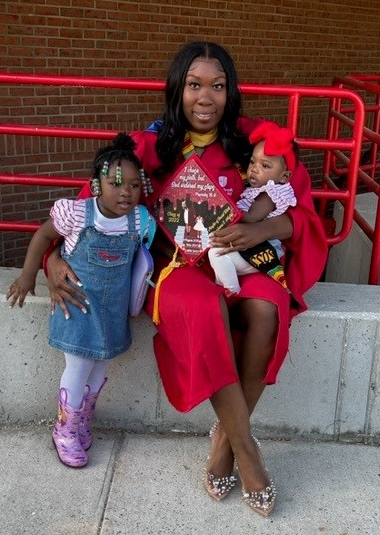
    Guyshana posing with her two daughters, holding her graduation cap.

    The Pregnant Scholar team recently spoke with Guyshana Alston, a mother of two who received her Master’s of Social Work in New York City. Keep reading to learn more about Guyshana’s story as a pregnant student and her desire to ensure all pregnant & parenting students know about their rights under Title IX. 

    How old are your children and when in your educational journey did you have them?

    I have a one-year-old and a two-year-old now. When I got accepted into the Master’s of Social Work program in 2019, I was pregnant with my first daughter. I was pregnant again in 2021. My children were with me throughout my academic career. I did it for them and with them. 

     What has your experience been in school? How did being pregnant as a student (or your school’s response) impact your experience? 

    My school was very unsupportive of my pregnancies both times. I was misinformed and had to go through many obstacles to get accommodations. I was told I needed to take time off and drop to being part time. I was forced to do an extra year due to lack of support from the school. I was sent to the different offices because nobody seemed to know which office supports pregnant students. During my first pregnancy I was lucky enough to find someone in the Title IX office that understood the rights of pregnant student and got the right staff to accommodate me by giving me extended due dates for assignments and allowing me to take classes virtually. When I wasn’t being helped during my second pregnancy, I reached out to that lady again but unfortunately, she was no longer at the university. When I wanted to make a complaint, I had to fill out a form called ‘Title IX Sexual Harassment’ since there were no forms for pregnant students to fill out. 

     What were some of the challenges you faced as a student parent?

    I was in a social work program that requires two internships to meet graduation. I had to really advocate to get a virtual internship. The school did not want to give me a virtual internship although I was pregnant and provided documentation. The professors were more supportive than administrative staff. Thankfully it was all virtual, but they were ok with me being on camera holding the baby or turning my camera off to nurse. I faced the challenge of having to delay my studies and take an extra year to complete the program. Also, my school was in the city of New York and there was no parking in the area. I had to explain to them why I didn’t want to take public transportation in the middle of a global pandemic to get to class. 

     From your perspective, what are the biggest challenges facing pregnant and parenting students? What can be done to counteract those challenges? 

    I think the biggest challenge is knowing where to go in the school for support. There’s nothing on the school website that acknowledges pregnant students or tells them their rights. It sends the message that pregnant students have no place on campus. I was sent to the student accessibility center, and nobody there could help me, and I was told pregnancy is not a disability. I’m naturally an advocate so I emailed the dean of students, Title IX staff and anyone that would hear me out to get accommodations. But I know other students may not be as empowered and me and may be forced to put their studies off when they don’t have to. I think at orientation pregnant and parenting students should be acknowledged. A short PowerPoint will go a long way. Even if there are no students pregnant at that time, the information will be helpful to get passed along and be useful for if a student becomes pregnant during their academic career.  Also, I think it will be important to have an on-campus student community for student parents to connect. 

     What does it mean to you that the support for pregnant and parenting students wasn’t always there? (If not stated above, what was the impact on you personally, professionally, how did you feel?) 

    I became a social worker to advocate and serve underserved populations. Being a pregnant student opened my eyes to the lack of inclusion for pregnant students. Although Title IX is a law, it’s not really publicized so many aren’t aware of it, including staff.  

     What are you most proud of accomplishing?  

    I’m most proud of getting my degree despite the many barriers I had to face. I was pregnant and parenting during a global pandemic. I am the first in my family to obtain higher education and I’m happy I got to do it with my daughters watching. Although they may have been too young to understand my accomplishment, they’ll be able to enjoy the fruits of my labor and know hard work pays off. Everyone praised me for graduating with two children under three years old. My children weren’t a barrier to my education—they were motivation. 

    What advice would you give to professors or administrators looking to support student parents? 

    I think they should be informed about resources on and off campus so they can share the knowledge with students who may not be aware. 

    What would you tell other student parents who are attending college and are in a similar situation? 

    I would tell them about their rights through Title IX. I wish someone would have told me. I would encourage them to keep on pushing and don’t drop out or take time off even if that is what is being told to them. Keep going for your children. 

    What’s next for you? What are your goals post-graduation? 

    After graduation, I became a certified doula to physically and mentally support women during childbirth. I want to support pregnant women in any capacity that I can. I also am a social worker working with vulnerable children & families in NYC. I have always been passionate about being a voice to those in need and now that I have seen firsthand the discrimination and lack of support pregnant students face in educational settings, I want to spread awareness. My goal is to advocate and do public speaking at universities to inform students of their rights and to build a community. 

    Go, Guyshana! Thank you for sharing your story. We’re rooting for you!

    Are you a pregnant or parenting scholar who wants to share their story? Reach out and let us know here. 
     

  • California AB 2881: New rights for parenting students in CA

    California AB 2881: New rights for parenting students in CA

    California has just enacted a new law to support parenting college students! The law is a unique and welcome addition; while roughly 1 in 5 college students is a student parent, there are only a handful of state laws designed to protect and aid this important student population. When it goes into effect in 2023, AB 2881 will require colleges and universities in California to provide priority registration for student parents, and to notify them of resources and supports critical to their success. California is now the first state to require educational institutions to provide priority registration for college student parents! AB 2881 is an important lever to address the needs of student parents, and it also supports higher education systems in reaching their goals to reduce equity gaps more broadly.  [UPDATE: review our AB 2881 Implementation Tools here]

    Priority registration is a best practice for supporting student parents

    Student parents often experience “time poverty.” While they are often excellent at time management, student parents have more responsibilities and inflexible time demands than the average student and therefore need more institutional support. AB 2881 requires campuses to have a priority registration process in place for student parents by July 1, 2023.

    Priority registration allows student parents to register for courses before some other students. This is an essential support that also benefits other students with important scheduling needs, such as students with disabilities and athletes. Student parents often navigate all the demands of higher education in addition to work, (often inflexible) childcare schedules and other parenting responsibilities. For example, a student parent may have to schedule courses around their child’s school drop off and pickup time or may want to build breaks into their day to make it easier to breastfeed without missing class. Others report needing priority registration to allow them to plan a course schedule that accommodates their disabled child’s medical appointments. Early registration is particularly important for students in programs with tight sequencing, or where required courses are only available once each year. By allowing student parents to have a wider choice of course scheduling options, priority registration ensures student parents will be less likely to have to choose between finishing their degree and being there for their families. 

    AB2881 sets the stage for better data collection on CA student parents 

    A lack of data on student parents has long slowed progress meeting their needs; if we don’t know how many student parents there are and where, how can we properly serve them? While AB 2881 doesn’t explicitly require colleges and universities to collect or report data on parenting students, it sets the stage for better data collection.

    Under the law, institutions can choose how they identify student parents (using the FAFSA, CADAA, or other documentation). At minimum, colleges and universities following the law must provide priority registration for student parents who have children under the age of 18 who receive more than half of their support from the student. This definition excludes many parenting students who need services, such as those who share custody or who are caring for adult children with disabilities, but it does provide a vital starting point for assessing the number of student parents at a particular institution, and a foundation for tracking their progress. If implemented thoughtfully, AB 2881 can build a foundation for future progress supporting parenting students in California colleges and universities. 

    Providing resource navigation will ease bureaucratic barriers 

    In addition to ensuring California colleges and universities develop a priority registration system for student parents, the new CA law also requires them to create a student parent webpage, sharing information about available resources on campus and in the larger community. This webpage must be published by February 1, 2023, and should include information about the priority registration system, as well as information about CalFresh, the California Earned Income Tax Credit, the Young Child Tax Credit, and the California Special Supplemental Food Program for Women, Infants, and Children (WIC).  

    [UPDATE: review our AB 2881 Implementation Tools here]  

    Institutions must provide the student parent webpage link to students as a part of campus orientations. Colleges and universities must also provide the student parent webpage link to faculty and encourage them to include the link in their syllabi. To ensure that the student parent internet webpage remains useful to student parents, AB 2881 requires that the webpage be reviewed and updated no later than the first day of every fall and spring semester or no later than the first day of every fall and spring quarter. 

    If you are a Title IX coordinator, university administrator, faculty member or student parent leader in California interested in hearing more, The Pregnant Scholar team will be hosting technical assistance sessions and other events to aid colleges in implementing AB 2881. Come join us! If you are not in California but want to learn more to support your own advocacy efforts you are also welcome to join.

    Sign up to receive future AB 2881 implementation tools and event invitations.

  • PREGNANT SCHOLAR PROFILE: Sade Johnson

    PREGNANT SCHOLAR PROFILE: Sade Johnson

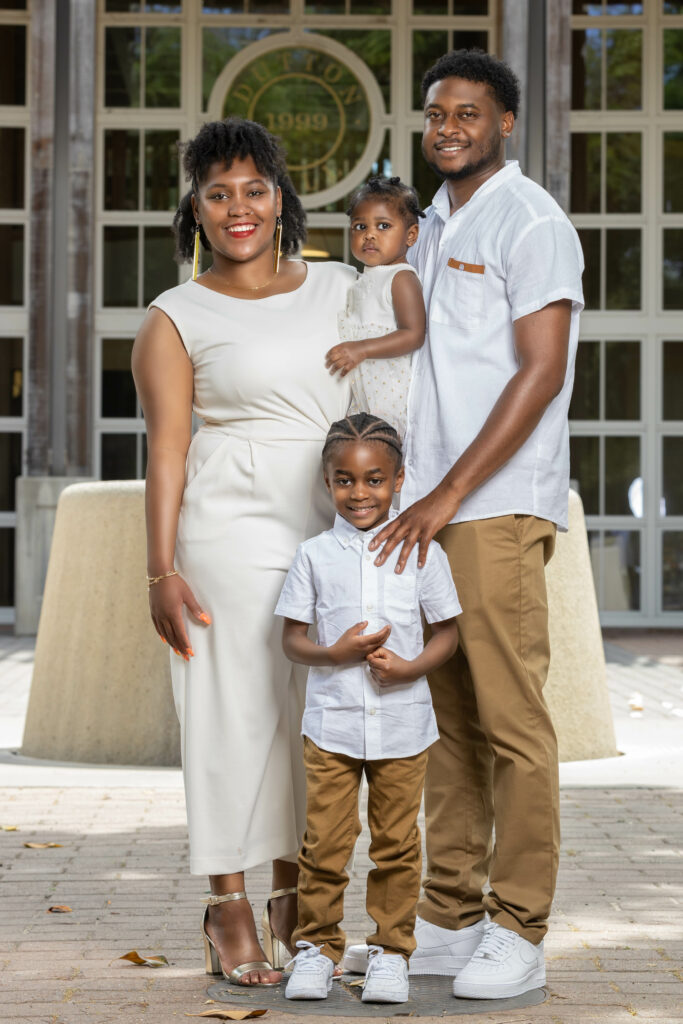
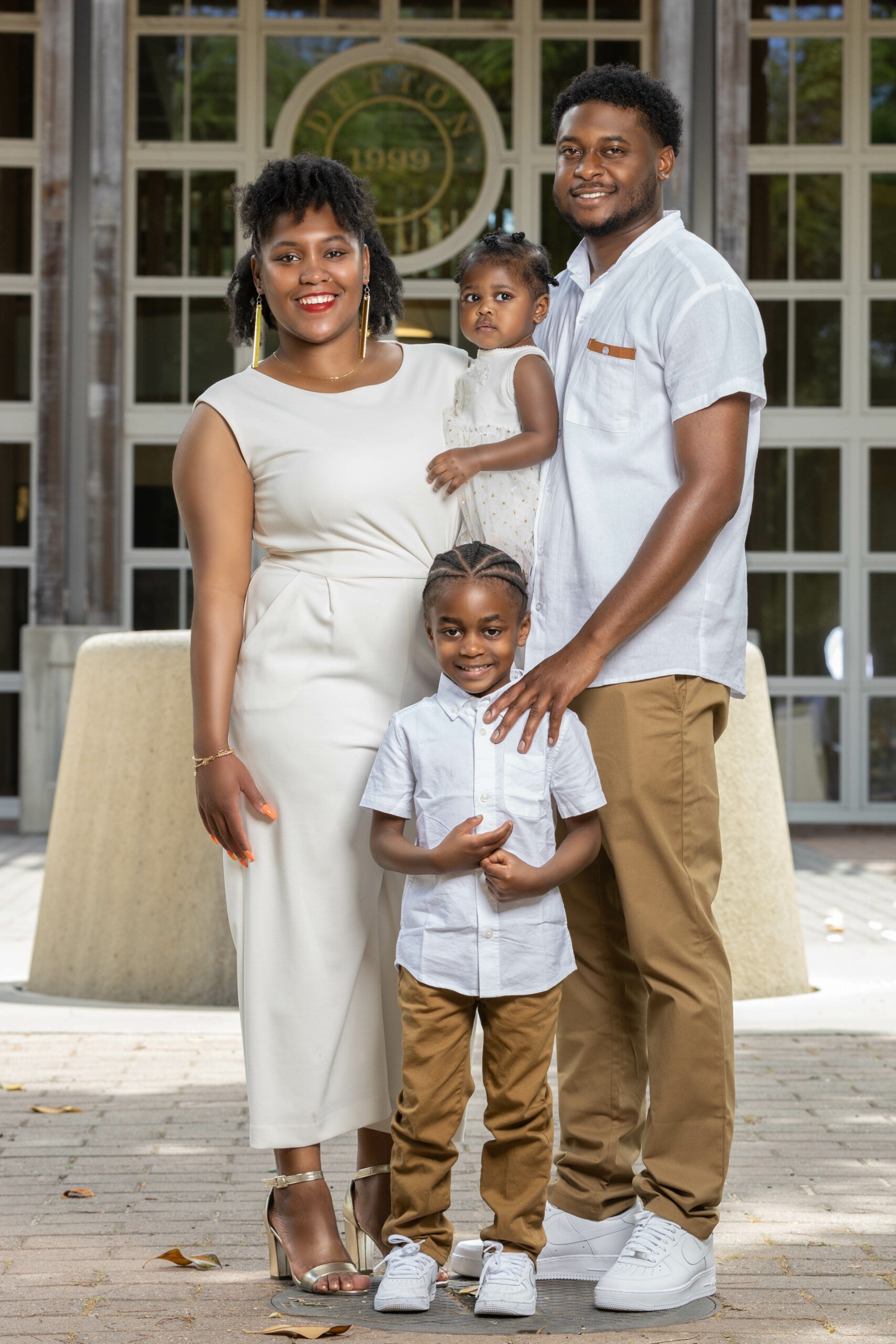
    Sade posing with her husband, son, and daughter.

    Sade is currently working towards her Master’s in Higher Education Administration & Leadership at California State University, Fresno. As a mother of two, Sade’s insight reveals important lessons about what works and what needs to be improved to best support pregnant and parenting students. 

    Read on to learn more about Sade’s story and to better understand the steps you can take to ensure pregnant students and student parents feel seen, valued, and heard on your campus.  

    Tell us a bit about you and your background. 

    I am a wife, mother of two children, and a student. My family comes first. I have been pregnant twice: once at community college (dual enrollment at Fresno City College and Clovis Community College) and once at the University of California Davis. I grew up in a big family; I have ten siblings, and I was system-impacted. My father was stuck in an incarceration cycle, and my mom could not afford to take care of us. I am also a first-generation college student.  

    How old are your children and when in your educational journey did you have them? 

    My son is 6 and my daughter is 2. The first time I was pregnant, I was at Clovis Community College after withdrawing from UC Davis. I had to take some time off.  I worked as a bus driver for a few years and made the decision not to return to school until my son was a little older and could attend daycare. I found out I was pregnant with my daughter when I decided to return to UC Davis.  

    Can you tell us about your experience as a student parent? 

    Some professors gave me grace. It was always helpful when professors let me take a final early or submit a paper early if needed, but I did not always feel supported. I was struggling with morning sickness, and my son was having a hard time in preschool. It was also hard to be away from our family and support system who were not in Davis.  

    I also didn’t like how UC Davis sets up student parents. I felt like my family was assigned housing that didn’t account for the fact that I was pregnant or that we had kids. For example, it was hard to go up and down stairs to do laundry, there were not enough washers and dryer for the complex, and many of them were broken, and we needed to purchase air purifiers and air conditioning units. After I gave birth, I could not physically go to class because of stitches and the 6-8 week recovery period. I was told that some academic departments “didn’t have enough money” to record classes when I could not be there, and when I decided to go down to part-time, they wanted to kick me out of on-campus housing, both of which were tough experiences to navigate.   

    My child is an extension of me, and I think it is important for schools to remember that. You can admit student parents, but it will not be impactful if you do not accommodate them. 

    What were some of the challenges you faced as a student parent? 

    I did not feel as if I belonged as a student parent. I also did not feel as if I belonged as a Black student. I was often the only Black person in class, and I know other students did not understand what it meant to be Black and to be pregnant and have a child.  

    Other challenges included balancing finances for tuition, childcare, and basic needs. It was also hard that services for student parents are not centralized and staff often did not talk to each other. It was clear that some staff had a gap in understanding and awareness about what support was available for student parents, and I had to implement self-advocacy. 

    When I was six months pregnant, I fainted. A professor told me I would get a zero on a quiz if I did not show up, but the lowest score the lowest grade would be dropped. She told me not to worry, but I wanted to have the choice to take the quiz. So instead of resting after I fainted, I was cornered and had to go to class anyway for the sake of my grades, as my housing depended on my grades and student status. 

    From your perspective, what are the biggest challenges facing pregnant and parenting students? What can be done to counteract those challenges?

    1. Focus on basic needs first. Student parents need somewhere to live, sleep and eat, and they also need childcare. It’s also important to ask student parents what they want; for example, at my job we take into consideration the type of gift cards we offer to student parents. Student-parents should have access to healthy food regardless of cost. Healthy meals are important to us and so are fast meals. It would also be great to have childcare on campus from 8AM- 8PM so that students can get all of their work done in that window. Campus-based childcare is limited and based on class schedule without considering the time students need to study or go to office hours. 
    1. Priority registration is a huge need so that student parents can register first and balance their childcare needs. They established this at UC Davis the year I left. Connecting the registrar’s office to student parents so that they can survey students and find viable class times would also be beneficial. 
    1. Family friendly spaces are needed. I do not bring my children to campus often, but when I do, it is great for people to be understanding. Classrooms could have tiny desks for children! And professors could work on their response for accommodation. They often ask “How old are they? Will they be a distraction?” and it makes me and my children feel unwelcome. Kindness is important. Family friendly events and mixers are awesome. 
    1. I think universities could also pull more on their student capital. For example, and like I said before, my children are an extension of me. I pay student fees, and it would be great to receive lessons and opportunities for my children on campus. Maybe there are other students on campus who need community service hours or could get credit for service-learning opportunities or want to get experience in working with children. This might look like music lessons, swimming lessons, kids’ play, or supplemental STEM programs. 

    What does it mean to you that the support for pregnant and parenting students wasn’t always there? 

    It caused a lot of confusion and doubt. If my household is failing, there is only so long I can stay in school, which impacts retention. It was hard to not have family-friendly spaces and centralized support—this would make things so much easier! 

    What are you most proud of accomplishing? 

    I thought I would be most proud of getting my degree, but I am most proud of parenting while getting my degree. My son and daughter will know about college; they saw me do it, and they saw me finish it. My children will not be first-generation college students. This was about pursuing something for me and also for them. It has also influenced my husband to go back and pursue a degree. 

    Is there anything else you want to share? 

    I want to reiterate that intersectionality matters. When I was giving birth to my daughter, I was thinking about the Black maternal mortality rate. My husband and son could not be with me because of COVID. I told the nurse that “I need to make it back home.” I needed to say that because I did not get to say goodbye to my family because of the intense contractions, and I need anyone who is working with Black mothers to remember that this is our reality. Also, my kids were born at God’s divine time which were at the end of semesters. This journey would have been so much harder if they were due in the middle of the semester or quarter. This reflects just how much more work is still needed. 

    What would you tell other student parents who are attending college and are in a similar situation? 

    If you are going to do it for anybody, do it for your children. I am not saying it’s going to be easy; it’s going to be hard. Never forget to be your voice even when people want to silence you. Find your community. Leave a change even if it is small. Many students have kids, so it’s important that we do not just focus on our own kids. The changes we make might not be perfect but at least we are working to create systems and support for those to come. And keep working to create pathways for our children and for following generations! 

    Go, Sade! The Pregnant Scholar Team can’t wait to see what else you accomplish!

    Are you a pregnant or parenting scholar who wants to share their story? Reach out and let us know here.

  • PREGNANT SCHOLAR PROFILE: Bianca Estrada

    PREGNANT SCHOLAR PROFILE: Bianca Estrada

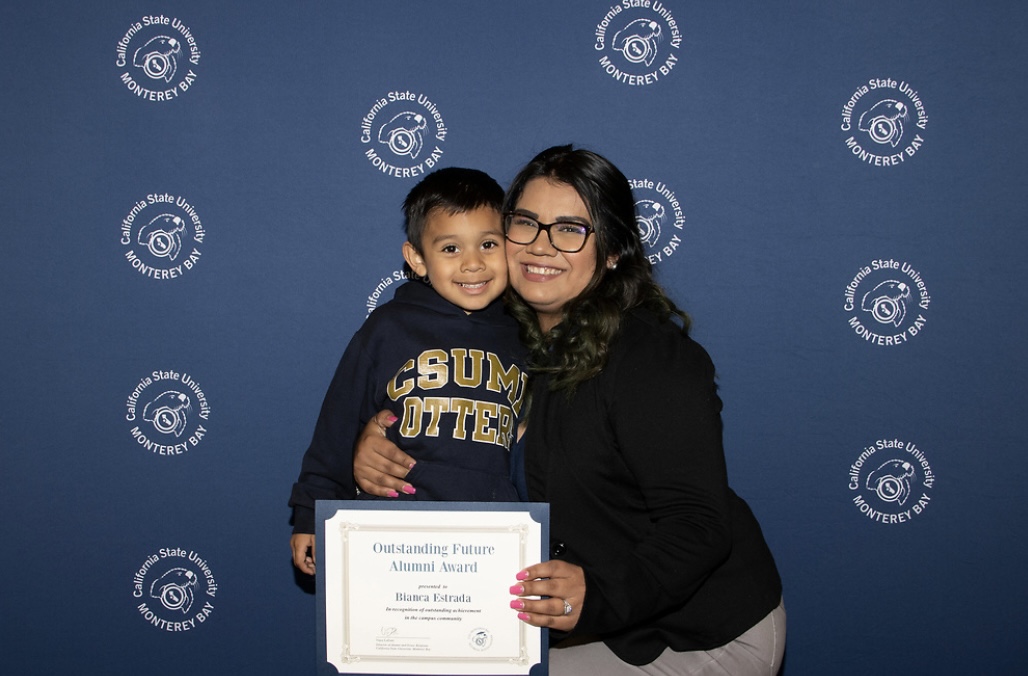
    Bianca posing with her son while holding an “Outstanding Future Alumni Award”.

    The Pregnant Scholar Team recently chatted with Bianca Estrada, a student parent and campus organizer at California State University Monterey Bay (CSUMB). Bianca is currently pursuing her Master’s of Social Work. She became a passionate advocate for pregnant and parenting students when she was pregnant and felt invisible on campus.

    Keep reading to learn more about what Bianca has been up to, including her successes and her challenges, and what she recommends for students who find themselves in a similar situation:

    How old is your son, and when in your education did you have him?

    My son is 5 years old. I found out I was expecting during my first semester as an undergrad and I gave birth in Spring 2017. I did have to take the remainder of that semester off; however, I returned in Fall 2017.

    What has your experience been in college? How has having your son impacted your experience? 

    As an undergraduate it was difficult. I felt invisible on campus, and the emotions I felt motivated me to become a passionate advocate for pregnant and parenting students. My experience at CSUMB has improved over the years; however, there is always room for improvement. My son has changed my life; parenting is scary but the most rewarding journey I could have asked for. Because of him, I found strengths I never knew I had: my voice, and my passion for advocacy. He is my daily reminder of why parenting students like myself pursue higher education. I recognize that to be a better person and a better parent, I will have to work hard to live the life we deserve. I have made it my goal to demonstrate the importance of education and to lead by example when it comes to my son.

    What is the most challenging part of being a student parent? What have you heard from other student parents about the challenges they face? 

    The most challenging part about being a student parent is initially the no sense of belonging, as we often have to wonder if we are allowed to bring our children to campus events. Also, the increased financial demands while pursuing higher education leaves parenting students feeling like they have to choose between being a parent or a student. 

    What are a few accomplishments you’ve helped lead on CSUMB’s campus to best support pregnant and parenting students? 

    1. Baby changing stations 
    1. Lactation rooms 
    1. Family friendly club 
    1. Family friendly study room in library 
    1. Currently working towards the CCAMPIS (Childcare Access Means Parents in School) grant 
    1. Let’s Talk Parent Wellness support group 
    1. Family Friendly Affinity Graduation 

    You can read more about Bianca’s accomplishments in the Monterey Herald and find more information about these resources on CSUMB’s website.

    What accomplishment was the most important to you personally, and why? 

    It is difficult to pick one. I would say the baby changing stations and the Family Friendly Library. The baby changing stations project was the moment I got out of my comfort zone; I found my voice and the power that comes with speaking up. The Family-Friendly Study Room is another example of me getting out of my comfort zone and grabbing an opportunity. It started as an idea for a grant proposal assignment and while my proposal was used as a template, I am very grateful for the family-friendly advisors and librarians who took this idea and made it happen.

    What would you say are the ‘top three’ challenges facing student parents on CSU-MB’s campus and what are your recommendations for solving those challenges?

    1. Data Collection: Collecting data on student parents is important because it visually highlights the need and it also helps the university provide adequate resources and support.  
    2. Basic Needs Policy: Amending the ‘basic needs’ policy on CSUMB’s campus would support expanding resources to the dependents of parenting students. It would also build a sense of belonging by including family-friendly events. 
    3. Student Parent Center: There is no designated location for parenting students to inquire about resources such as a one-stop Student Parent Center. This [would be] an important resource because it provides a sense of community and support and is a designated safe place where children are welcomed while parents learn about resources available to them on campus. In addition it would be helpful to have off-campus connection outreach (for example, a representative for CalWORKs, Women Infant Children (WIC), and other agencies). 

    What is the best part about working with other student parents on your campus? 

    The best part about connecting with other parenting students on campus is building, promoting, and strengthening an inclusive community which includes growing relationships and support systems.  

    If you could give one piece of advice to student parents on advocating for change on campus, what would it be? What do you wish you knew when you were first starting this work? 

    Don’t be afraid to speak up! Your voice matters. The right person will listen. When you come across that person hold on to them and continue to build connections.  

    Tell us about your long-term vision for CSUMB’s campus and its student parents.

    My long-term vision for the CSUMB’s campus is to continue to recognize parenting students and promote a family-friendly campus. I also want to partner with other organizations in Monterey Bay to ensure student parents have access to support and resources both on- and off-campus.  

    What’s next for you? What are your goals post-graduation? 

    I want to continue working with parenting students as an off-campus connection and explore programs and resources around maternal mental health. My ultimate goal is to someday open a non-profit where resources will be available to parents who would like to pursue higher education. I am not sure what it would look like exactly but my vision is to help as many parents reach their goals!

    If you could speak directly to other student parents who are facing challenges getting their degree, what would you tell them? 

    I know it’s hard, and I know sometimes quitting doesn’t sound so bad, but I am here to tell you my secret: when I feel just like you must be feeling now, I look at my son, I hug my son, and when he tells me he loves me I remember my WHY. My son deserves a future he can be proud of. Kids are smart, talk to them about why you go to school, why you stay up doing homework late, talk to them about why you have so many meetings. Including your kids in the process doesn’t take away the challenges, but it does create memories and motivation.

    Go, Bianca! The Pregnant Scholar Team is rooting for you!

    Are you a pregnant or parenting scholar who wants to share their story? Reach out and let us know here.